United States · Document preparation
How Detailed Should a Construction JHA Be?
A construction Job Hazard Analysis (JHA) can become unhelpful in two ways: one row covers the whole job, or dozens of rows describe every small movement. The useful level of detail lets a reviewer see where the task, hazards or work environment change.
OSHA’s JHA guidance recommends avoiding both excessive detail and broad steps that miss basic activities. There is no useful page target to chase; focus on whether the analysis describes the work clearly.
Free JHA worksheet and illustrative example
Use the English-language blank worksheet to collect the job, location, meaningful task steps, potential hazards, proposed controls and questions for review. The office fit-out PDF shows a sample format; it is separate from the Dallas partition-installation brief in this article.
Download free JHA worksheet (CSV)
Opens a free CSV in Excel or another spreadsheet. No registration required.
Preview the example JHA
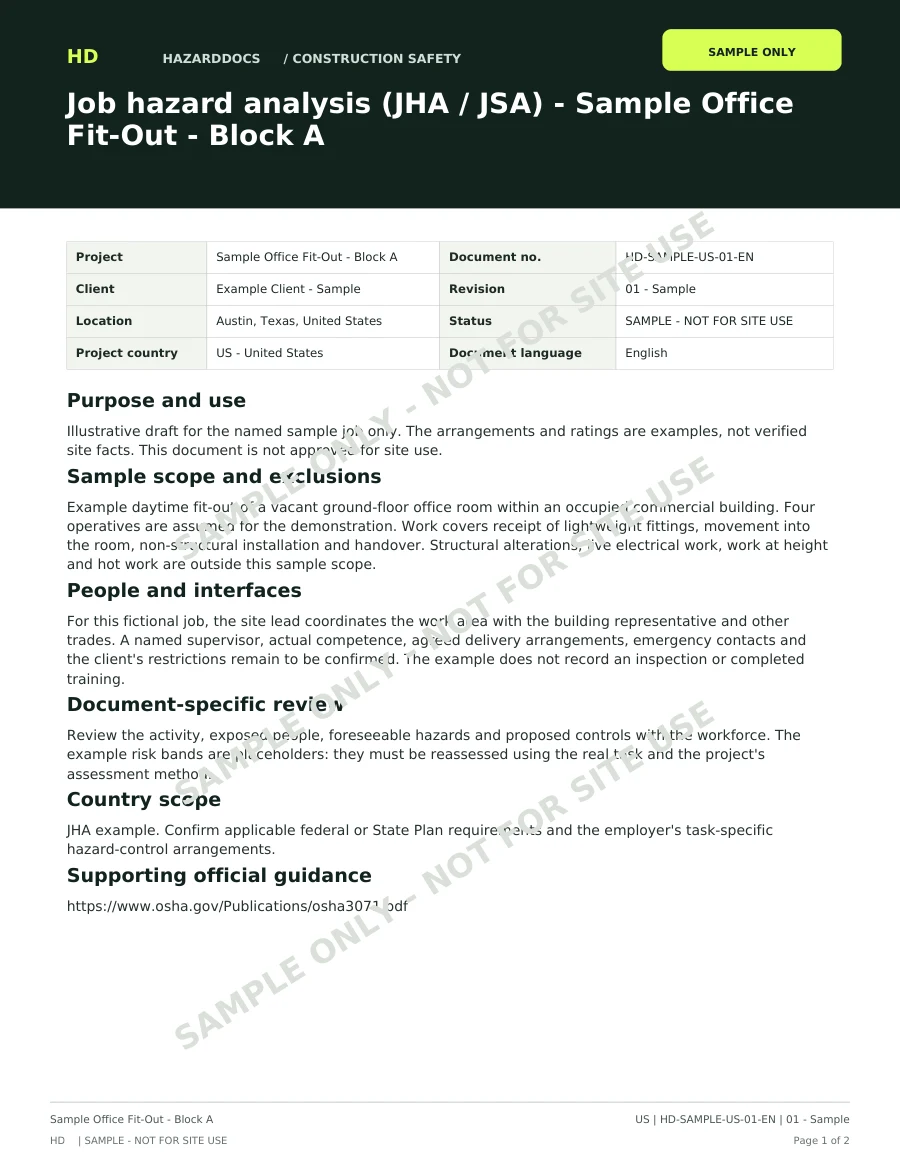
Illustrative sample only. Not for site use.
A preparation aid, not an approved JHA or OSHA certification. Confirm actual work conditions, applicable requirements and controls with the responsible team before use.
Define the job before counting rows
Consider a subcontractor preparing a JHA for interior partition installation during a Dallas retail tenant-improvement project. “Complete the fit-out” includes work belonging to other trades. “Install partitions in the rear stockroom” gives the discussion a clearer boundary.
Record the location, crew, proposed materials and equipment, and the work included in this draft. Note whether deliveries, adjacent operations or occupied areas affect the task. This background helps explain why a familiar activity needs a different assessment on this site.
Use changes in the work as a drafting prompt
As a practical editing check, ask whether a step contains several distinct activities, locations or groups of people. If it does, the reviewer may need a clearer breakdown. At the other extreme, several rows describing essentially the same activity may add little useful information.
A new row is not automatically a new safety measure. Its purpose is to make the relevant hazard and proposed control easier to assess. Decide the final breakdown with people who understand the actual work.
| Draft label | Question for the reviewer |
|---|---|
| Complete interior work | Does this combine unrelated tasks and contractors? |
| Receive materials at the agreed unloading area | Is the delivery interface described clearly enough? |
| Partition assembly in the rear stockroom | Does this need further division for this job? |
| Pick up item; turn; take one step | Would these movements be clearer within a meaningful activity? |
Ask the people doing the work
OSHA recommends employee involvement and checking the job-step outline with the worker. Use that discussion to find missing activities rather than judge someone’s performance.
For the Dallas example, ask the crew whether the proposed stockroom access matches what they have seen. Ask the superintendent about overlapping trades and delivery timing. If the answers differ, record the issue for resolution instead of choosing whichever answer makes the draft shorter.
Keep the JHA within its proper role
A task JHA is one part of safety planning. Federal construction standard 1926.20(b) separately addresses employer safety programs and regular inspections by designated competent persons. Completing a JHA does not replace those responsibilities.
This article uses federal OSHA guidance. Confirm any applicable State Plan requirements and project-specific document expectations rather than assuming every US project uses the same form or review process.
Review the meaning, not the document length
Before issuing the draft, ask whether a supervisor can identify the activity, location and unresolved assumptions without asking the writer to explain every row. Remove repeated filler and clarify anything that could describe several different jobs.
AI creates a draft requiring site-specific review by a competent person familiar with the task. That review must check the job steps, hazards and proposed controls against actual conditions. A tidy table alone does not establish that the work has been assessed properly.
Sources
- OSHA 3071: Job Hazard Analysis (2002, revised)
- OSHA: 29 CFR 1926.20, General safety and health provisions
Sources provide background information; they do not endorse HazardDocs.